






Almost a decade after its creation, the experimental poetry movement Flarf—in which poets prowl the Internet using random word searches, e-mail the bizarre results to one another, then distill the newly found phrases into poems that are often as disturbing as they are hilarious—is showing signs of having cleared a spot among the ranks of legitimate art forms. Despite the group's penchant for shocking content and outrageous titles (Sharon Mesmer's "Annoying Diabetic Bitch," for example, or Gary Sullivan's "Grandmother's Explosive Diarrhea"), many in the literary world are taking the poems seriously.
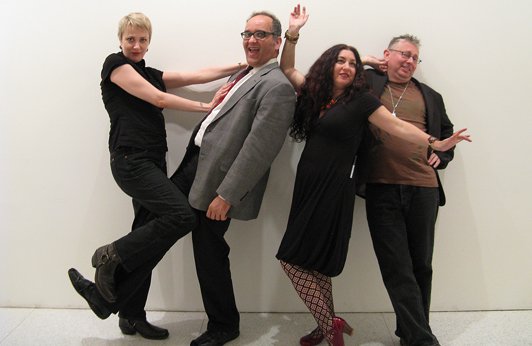
So far, at least sixteen books of Flarf have been published—a flurry of them just in the past several years. Since 2006, the Bowery Poetry Club in Manhattan has held an annual three-day Flarf Festival that features poetry as well as "flarfy" music, theater, and film. Last September a group of Flarf poets were invited to read at the Walker Art Center in Minneapolis. In April, New York City's Whitney Museum of American Art hosted its own Flarf reading. And in November, Washington, D.C.–based independent publisher Edge Books will release a four-hundred-page anthology, Flarf: An Anthology of Flarf, featuring the work of twenty-five to thirty poets.
The seed for Flarf was planted in New York City in 2000, soon after poet Gary Sullivan learned that his dying grandfather had been scammed by the International Library of Poetry, the now-defunct organization that purported to hold poetry contests, yet accepted every poem it received, asking "winners" to pay fifty dollars for a copy of an anthology featuring their poem. As a prank, Sullivan submitted the worst poem he could write. The poem, titled "Mm-hmm," began: "Yeah, mm-hmm, it's true / big birds make / big doo! I got fire inside / my ‘huppa'-chimp(TM) / gonna be agreessive, greasy aw yeah god / wanna DOOT! DOOT! / Pffffffffffffffffffffffffft! hey!"
After receiving the obligatory embossed letter telling him he'd "won," Sullivan passed the poem around to a group of his poet friends, who in turn submitted their own terrible poems to the site. Before long, they started penning and sending these "bad" poems to one another, more poets joined in, and a private Listserv was born.
"To be honest with you," Sullivan says, "we started this list to do a hundred-page anthology of just garbage." To create such garbage, the group latched onto a technique poet Drew Gardner had been using to construct his own work: searching the Internet for random terms and crafting the results into poems. Soon, the poets started riffing off one another's lines and competing to create the most outrageous pieces. Sullivan used this technique to write a poem titled "Flarf Balonacy Swingle," and the collective quickly adopted Flarf as a verb, adjective, and noun to describe what they were doing. They were "flarfing" their "flarf" poems, which were, of course, "flarfy."
But then a funny thing happened: Their poems evolved from "bad" to "sort of great," Gardner says. "What we were really doing was throwing out rules that were constraining and ridiculous and weren't fitting anymore. Once we did that, we could do whatever we wanted—we weren't trying to ask: Is this magazine going to like this? Is this poet going to like this? Is my teacher going to like this? We just got rid of all of it and went nuts."
Edge Books publisher Rod Smith, a poet himself, says he feels the collective is prompting a bit of anarchy in the poetry world by widening the vocabulary of what is permissible. "Aesthetic judgments about what's bad in a very hierarchal society are usually serving upper-class people with a certain amount of privilege," he says. "So for a bunch of poets who are very well schooled in a variety of traditions of American poetry to take what's considered bad and throw that at people is a very interesting maneuver. It's not simply bad poetry; it's quote-unquote bad poetry written by people who know how to write poetry."
Still, with its subversive stance, meta-mind mentality, pop-culture detritus, and mildly offensive language—this edgy new art form is difficult to pin down. Poet Sharon Mesmer describes the process this way: "There's this idea that juxtaposition creates a little pop in your mind to take you out of your immediate, mundane reality. When we do these crazy things with Google, a lot of times we're putting something beautiful together with something ugly, and it makes this third thing that is completely delightful and unexpected."
In any case, the poems are not something most would want their children reciting around the house. In fact, Flarf has also generated what Gardner terms "a lot of angry ill will in the poetry world." In 2006, Dan Hoy wrote an article critical of Flarf for Jacket magazine that sparked heated discussions on dozens of poetry blogs. "I had problems with the positioning of Flarf as a kind of liberating force," Hoy says, "as well as the marketing of Flarf as a kind of neo-Dada thumbing its nose at the establishment, which is embarrassing."
Poet Douglas Rothschild, host of the Poetry Game Show, regularly employs words like "terrible," "offensive," and "stupid," when describing Flarf (which he prefers to spell Phlarugh). "It's all geared toward entertainment and punch lines and maybe a teeny little insight thrown in at the end," he says. "Poetry isn't on my list of entertainment, it's more important than that."
Good or bad, Flarf has elicited sufficient controversy—and attracted enough followers as well as detractors—to last a decade. And that's likely more than Sullivan could have hoped for when he dashed off "Mm-hmm" and dropped it in the mail.
Shell Fischer is a Brooklyn, New York–based freelance writer. The initial chapter of her completed first novel, "The Joy of Mom," recently won the 2009 Bronx Center for the Arts Chapter One Award.
Comments
MJ replied on Permalink
Good Article.
monica9965 replied on Permalink
Flarf
bmosher replied on Permalink
Poets might end up taking